

Finding the right swim trunks often feels like balancing style with genuine environmental commitment. For men who value both aesthetics and responsibility, the conversation around ethical beachwear goes deeper than simple marketing claims. Understanding how your choices influence environmental outcomes, fair labor standards, and garment longevity lets you select swimwear that truly reflects your priorities. This guide clarifies the myths and realities behind ethical beachwear, helping you make informed decisions that align style with substance.
Table of Contents
- Ethical Beachwear Defined And Common Myths
- Types Of Sustainable Beachwear Materials
- Environmental Impact Of Ethical Swimwear
- Fair Labor And The Fashion Supply Chain
- Financial And Lifestyle Benefits For Investors
- Ethical Vs. Conventional Beachwear Choices
Key Takeaways
| Point | Details |
|---|---|
| Ethical Beachwear Benefits | Ethical beachwear offers long-lasting quality, reducing replacement frequency and environmental impact. |
| Cost-Per-Wear Economics | Investing in ethical swimwear often proves more economical over time than purchasing cheaper conventional options. |
| Consumer Influence | Individual choices drive market demand, encouraging brands to expand sustainable practices and options. |
| Material Awareness | Understanding the sourcing and production processes of beachwear can guide consumers towards more environmentally responsible choices. |
Ethical Beachwear Defined and Common Myths
Ethical beachwear isn’t just a marketing buzzword. It refers to swimwear and beach apparel produced with genuine consideration for both environmental impact and the people who make it. This means looking at the entire supply chain—from the materials sourced to the factory conditions to the packaging used. Sustainable fashion approaches emphasize how ethical apparel balances three core pillars: environmental responsibility, social fairness, and economic viability.
When you’re shopping for swim trunks, ethical beachwear typically meets these standards:
- Eco-friendly materials sourced responsibly, such as recycled fabrics, organic cotton, or regenerated fibers from responsible producers
- Transparent manufacturing with fair wages and safe working conditions for factory workers
- Minimal waste production through efficient design and sustainable packaging choices
- Reduced ocean pollution by avoiding harmful chemicals and microplastics in the manufacturing process
- Long-lasting quality that encourages you to keep wearing pieces longer rather than replacing them annually
The reality differs sharply from what many people believe about ethical beachwear. Several persistent myths cloud the conversation and prevent men from making informed choices about what they buy.
Myth One: Ethical Beachwear Costs Significantly More
This is partially true but oversimplified. Yes, ethically-produced swim trunks sometimes cost more upfront than mass-produced alternatives. But here’s what most people miss: ethical beachwear lasts longer. A quality pair of sustainable swim trunks survives multiple seasons of beach trips, pool days, and washing cycles. Compare that to cheaper trunks that fade, lose elasticity, or develop tears within one year, and you’re actually spending less per wear over time.
Many brands, including those focused on ocean conservation and ethical production, offer competitive pricing through smart design and efficient operations. Some use seasonal sales and discounts strategically, making ethical options accessible without breaking your budget.
Myth Two: Ethical Production Can’t Match Quality or Style
This outdated assumption ignores how the market has evolved. Ethical beachwear brands now compete directly with mainstream retailers on design, fit, and durability. You’re not choosing between looking good and feeling good about your purchase—you get both. Modern sustainable swim trunks feature contemporary cuts, solid color options, and refined aesthetics that appeal to men who care about how they look at the beach.
Better yet, ethical brands often emphasize durability as a design feature. This means reinforced seams, quality zippers, and fade-resistant fabrics that maintain their appearance after dozens of washes.
Myth Three: One Individual’s Choice Doesn’t Matter
This myth paralyzes people into inaction. The truth: collective consumer behavior shapes entire industries. When enough men choose ethical beachwear, brands respond by expanding sustainable options and improving their practices. Your purchase sends a market signal. Manufacturers see demand and adjust production accordingly. This isn’t hypothetical—it’s how consumer pressure drives change across fashion industries.
Every purchase is a vote for the kind of manufacturing practices and environmental standards you want to see in the market.
When you invest in ethical beachwear, you’re participating in a shift toward more responsible ocean-related products and practices. Beyond personal satisfaction, you’re contributing to measurable change in how the industry operates.
Myth Four: All Sustainable Brands Are the Same
Not even close. Ethical beachwear exists on a spectrum. Some brands focus primarily on ocean conservation, others prioritize fair labor practices, and some emphasize circular economy principles. Some use recycled materials, while others source organic fibers from certified suppliers. The key is understanding what matters to you and researching specific brands’ commitments. Read labels, check supply chain transparency statements, and look for third-party certifications that verify their claims.
When choosing ethical beachwear, you’re making an informed decision based on your personal values and the specific impact you want to support.
Pro tip: Look beyond marketing language—check if a brand publicly shares information about its factories, material sourcing, and environmental certifications, as transparency is a reliable indicator of genuine ethical commitment.
Types of Sustainable Beachwear Materials
The material your swim trunks are made from determines their environmental footprint more than almost anything else. Different fabrics have vastly different impacts on water usage, chemical pollution, carbon emissions, and ocean health. Understanding what goes into your beachwear helps you make choices that align with your values. The good news is that sustainable material options have exploded in recent years, giving you real alternatives to conventional synthetics and conventionally-grown cotton.
When evaluating beachwear materials, you’re really comparing their lifecycle impact. Sustainable fashion materials are assessed on factors like water consumption during production, pesticide and chemical use, how biodegradable they are, and what happens to textile waste. Some materials excel in one area but struggle in another, which is why understanding the tradeoffs matters.
Recycled Synthetics and Ocean Plastics
Recycled polyester and nylon represent one of the most innovative solutions in sustainable beachwear. These materials take existing plastic waste—sometimes literally recovered from oceans, though more commonly from post-consumer textile scraps and industrial byproducts—and transform them into high-performance fabrics. The appeal is straightforward: you’re keeping material out of landfills and oceans while creating functional swimwear.
The benefits include:
- Reduced virgin plastic production, which cuts fossil fuel consumption significantly
- Strong performance characteristics that make these fabrics ideal for swimming, stretching, and chlorine resistance
- Quick-drying properties that outperform many natural fibers
- Durability that means your swim trunks maintain their shape and color through many seasons
- Lower water usage compared to both conventional synthetics and natural fiber production
The trade-off here is that recycled synthetics are still plastic, meaning they don’t biodegrade. However, they’re designed to last decades, which reduces your need to replace them frequently. Some recycled fabrics release microplastics when washed, though manufacturers are developing solutions to minimize this.
Organic Cotton
Organic cotton eliminates pesticides and synthetic fertilizers from production, which protects soil, waterways, and the workers handling the crop. It still requires significant water—roughly 1,800 gallons per pound—but uses dramatically less water than conventional cotton production because it relies on rainfall rather than intensive irrigation in many growing regions.
Organic cotton feels softer against skin and breathes well, making it comfortable for beach lounging and warm climates. It’s biodegradable and non-toxic, meaning at the end of its life, it returns to the environment without leaving harmful residues. The downside: pure organic cotton isn’t ideal for swim trunks because it absorbs water, takes longer to dry, and loses its shape when wet. Most ethical brands blend organic cotton with other fibers to improve performance.
Regenerated Fibers from Plant-Based Sources
Fabrics like Tencel (lyocell) and viscose represent middle ground between synthetics and natural fibers. These materials start with plant cellulose—typically from sustainably managed forests—which is chemically processed into fiber form. The manufacturing process uses eco-friendly fiber production methods that recycle most chemical solvents, reducing pollution compared to viscose alternatives.
Regenerated fibers offer several advantages:
- Soft, smooth texture that feels luxurious against skin
- Biodegradable unlike synthetics
- Lower water consumption than conventional cotton
- Strong even when wet, making them suitable for swim applications
- Dye-absorption properties that allow for rich colors without excess chemical dyes
The most sustainable beachwear often combines two or three materials, leveraging each fiber’s strengths while minimizing individual weaknesses.
Hemp and Linen Blends
Hemp requires minimal pesticides, grows quickly without depleting soil, and produces strong fibers. When blended with other materials—often recycled synthetics or organic cotton—it creates durable, naturally resistant-to-mildew fabric. Linen offers similar benefits with even softer texture. These natural fibers work best in beach shirts and cover-ups rather than swim trunks themselves, but they’re gaining popularity in hybrid designs.

Material Comparison at a Glance
| Material | Water Usage | Durability | Drying Speed | Biodegradable |
|---|---|---|---|---|
| Recycled polyester | Low | High | Fast | No |
| Organic cotton | High | Moderate | Slow | Yes |
| Tencel/Lyocell | Low-moderate | High | Fast | Yes |
| Hemp blend | Low | High | Moderate | Yes |
The reality is that no single material is perfect. Your choice depends on which environmental concerns matter most to you. If ocean plastic pollution drives your decisions, recycled synthetics are compelling. If pesticide impact on farming communities concerns you, organic cotton blends make sense. If biodegradability is your priority, regenerated fibers offer practical solutions.
Pro tip: Check product descriptions for fiber composition percentages and certifications like Global Organic Textile Standard (GOTS) or Cradle to Cradle, which verify the environmental claims brands make about their materials.
Environmental Impact of Ethical Swimwear
Conventional swimwear production carries a hidden environmental cost that most men never consider when they grab trunks off a store shelf. Traditional textile manufacturing ranks among the world’s most resource-intensive industries, consuming vast quantities of water, releasing toxic chemicals into waterways, and generating significant carbon emissions. Ethical swimwear directly counters this by reimagining how beachwear gets made, from material sourcing through final production. Understanding these environmental benefits helps you see your purchase as more than just a style choice—it’s an investment in ocean and ecosystem health.
The contrast between conventional and ethical production is stark. Traditional synthetic swimwear relies on petroleum-based plastics manufactured through energy-intensive processes. Conventional cotton farming consumes roughly 16 percent of the world’s pesticides while using only 2.5 percent of cultivated land. These chemicals leach into soil and water systems, harming aquatic life and contaminating drinking water sources. Environmental impacts of textile production reveal that conventional swimwear manufacturing generates pollution at multiple stages, from fiber production to dyeing to packaging. Ethical swimwear eliminates or dramatically reduces these harmful practices.
Water Conservation Through Sustainable Practices
Water consumption represents one of the most measurable environmental differences between conventional and ethical beachwear. Producing a single pair of conventional cotton swim trunks requires approximately 2,700 liters of water. That’s the drinking water for one person for over three years, used for just one garment.
Ethical beachwear significantly reduces this footprint through multiple approaches:
- Recycled materials require no water for fiber production since the material already exists
- Organic cotton farming relies on rainfall and improved soil management rather than intensive irrigation
- Regenerated fibers like Tencel use closed-loop manufacturing where water is recycled within the facility
- Hemp and linen production demands far less water than conventional cotton
- Efficient dyeing processes recycle water multiple times before release
A single switch to ethical swimwear saves thousands of liters of freshwater annually when compared to conventional alternatives. Multiply that by thousands of men making the same choice, and you’re talking about preserving water reserves that communities actually depend on for drinking and agriculture.
Chemical Elimination and Ocean Protection
Conventional textile manufacturing relies on hazardous chemicals at nearly every stage. Pesticides in cotton farming contaminate groundwater. Heavy metals used in dyeing accumulate in aquatic ecosystems. Bleaching agents and synthetic dyes enter rivers and coastal waters, creating dead zones where aquatic life cannot survive. Workers in conventional factories handle these chemicals without adequate protection, leading to serious health consequences.
Ethical swimwear eliminates or restricts these harmful chemicals. Manufacturers use natural dyes, plant-based processing agents, or closed-loop systems that prevent chemical release. No pesticides means no agricultural runoff poisoning waterways. Ethical obligations toward natural ecosystems motivate companies to minimize resource exploitation and pollution, which directly translates to cleaner oceans and healthier marine life.
This matters because you’re wearing your swimwear in the ocean. Those same waterways are home to coral reefs, fish populations, and marine mammals. Reducing chemical pollution from your beachwear means the beaches you swim at remain healthier and more biodiverse.
Carbon Footprint Reduction
Transporting conventional swimwear across global supply chains generates significant carbon emissions. Ethical brands often manufacture closer to markets, reducing shipping distances. Recycled materials require less energy to process than virgin synthetics. Organic farming methods build soil carbon rather than depleting it.
While exact carbon reduction varies by brand and material choice, choosing ethical swimwear typically cuts your beachwear’s carbon footprint by 30 to 50 percent compared to conventional options. Some brands achieve even greater reductions through renewable energy use and carbon offset programs.
Your choice of ethical swimwear prevents hundreds of kilograms of chemical pollution, thousands of liters of water waste, and significant carbon emissions—all for a single garment you’ll wear for years.
Long-Term Environmental Impact Through Durability
One often-overlooked environmental benefit comes from durability. Ethical swimwear is engineered to last. You wear quality trunks for 5 to 10 years instead of replacing cheap alternatives annually. This dramatically reduces your lifetime environmental footprint because producing fewer garments means fewer resources consumed overall.
A cheap pair of conventional swim trunks might cost less upfront but requires replacement every year or two. Over a decade, you’ve created far more waste and consumed far more resources. Ethical swimwear’s superior construction means fewer replacements and less environmental impact spread across your lifetime.
Pro tip: Look for brands that publicly share their water savings, chemical reductions, and carbon offsets—these metrics help you understand exactly what impact your purchase prevents.
Fair Labor and the Fashion Supply Chain
When you buy conventional swimwear, you’re supporting a supply chain that often exploits workers. Most men don’t realize this because the problem happens thousands of miles away, hidden behind factory walls and opaque supply chains. The fast fashion industry relies on keeping costs artificially low by cutting corners on labor practices. Workers in conventional fashion factories earn poverty wages, work 14-hour days in unsafe conditions, and face retaliation for speaking up about problems. Some face outright forced labor, with debt bondage trapping them in cycles of exploitation.
Ethical beachwear fundamentally reimagines this system. Instead of maximizing profit by minimizing labor costs, ethical brands view fair wages and safe working conditions as non-negotiable requirements. This shift matters more than you might think. When you invest in ethical swimwear, you’re directing money toward companies that respect human dignity and transparency. You become part of a demand signal that rewards responsible business practices.
Understanding what happens behind the scenes helps you make informed choices. Labor exploitation in fast fashion supply chains reveals systematic abuse—wage theft, excessive overtime without compensation, dangerous machinery, poor ventilation, and chemical exposure without protective equipment. Women and migrants face particular vulnerability, often subject to sexual harassment and discrimination alongside these basic labor violations. The system is designed to be hidden from consumers.
What Fair Labor Actually Means
Ethical beachwear brands commit to concrete labor standards that go far beyond legal minimum wages in developing countries. Fair labor practices include:
- Living wages that cover basic needs like housing, food, healthcare, and education in the worker’s actual location
- Safe working conditions with proper ventilation, fire safety systems, and protective equipment
- Reasonable hours limiting excessive overtime and protecting workers’ personal time
- Freedom of association allowing workers to organize and negotiate collectively
- No child labor and age-appropriate working conditions for younger workers
- Transparent supply chains with clear documentation of every manufacturing facility
- Third-party auditing from independent organizations that verify compliance
- Worker grievance mechanisms allowing employees to report problems without fear of retaliation
These aren’t just nice-to-have features. They represent fundamental human rights that ethical brands recognize as essential to responsible business.
The Hidden Costs of Conventional Swimwear
Conventional brands keep prices low through labor exploitation. A factory worker in Bangladesh might earn $3 per day while producing swimwear that sells for $50. That gap isn’t efficiency—it’s exploitation. The worker cannot afford adequate housing or healthcare. Their children miss school to work. Exposure to chemicals in poorly ventilated factories causes respiratory diseases and skin conditions.
Hidden forced labor in fashion supply chains demonstrates that some workers face debt bondage, passport confiscation, and threats to their families. They cannot leave because they’re trapped in manufactured debt cycles. This isn’t ancient history—it’s happening right now in factories producing clothes for major brands.
When you buy cheap conventional swimwear, you’re voting with your dollars for these practices to continue. Your purchase signals that you’re willing to accept human suffering as the price of a bargain.
How Ethical Brands Verify Fair Labor
Ethical beachwear companies prove their commitment through transparency and third-party verification. Look for these indicators:
Fair Trade Certification means independent auditors verified working conditions, wages, and worker rights against strict international standards.
Supply chain transparency involves brands publicly listing their manufacturing facilities, often with visitor information and audit reports available online.
Worker testimonials from actual employees describing their experience provide authentic insight into real conditions.
Living wage commitments going beyond legal minimum requirements show prioritization of worker dignity over maximum profit.
Regular audits by independent organizations—not the brands themselves—ensure ongoing compliance.
When you choose ethical swimwear, you’re paying fair wages for fair work, allowing factory workers to support their families, send their children to school, and maintain their health and dignity.
The Real Cost of Responsibility
Ethical swimwear sometimes costs more upfront because workers are actually paid fairly. But here’s what matters: that extra cost goes directly to people who make your clothes. A factory worker earning fair wages can afford healthcare for their family. Their children attend school instead of working. They live with dignity and security.
Meanwhile, conventional brands pocket the difference between exploitative wages and retail prices. When you choose ethically-made swimwear, you’re redirecting that profit toward human wellbeing instead of shareholder dividends.
Pro tip: Before purchasing, check the brand’s website for supply chain transparency documentation—reputable ethical companies proudly display factory locations, worker information, and third-party audit reports, while conventional brands avoid this disclosure entirely.
Financial and Lifestyle Benefits for Investors
Investing in ethical beachwear isn’t purely altruistic—it’s a smart financial decision with tangible lifestyle benefits. Men who choose sustainable swimwear aren’t just making feel-good purchases; they’re making strategic choices that enhance their lives while supporting companies with stronger financial fundamentals. The economics of ethical fashion have shifted dramatically over the past decade. Brands prioritizing sustainability and fair labor practices report higher customer retention, stronger brand loyalty, and better long-term profitability than their conventional competitors.
When you buy ethical beachwear, you’re supporting a growing market segment that outperforms conventional fashion on nearly every business metric. Consumer attitudes toward sustainable fashion demonstrate that purchasers of ethical apparel show significantly higher brand loyalty and repeat purchase rates. These aren’t one-time buyers grabbing whatever’s cheapest. They’re committed customers who return repeatedly, spend more per transaction, and recommend brands to friends. From a business perspective, that translates to stable revenue, predictable growth, and resilience during economic downturns.
The financial benefits extend beyond the companies you support. Your personal investment in quality ethical beachwear creates measurable savings through durability and longevity.
The Cost-Per-Wear Economics
Here’s a calculation most men never do: cost per wear. A $150 pair of ethical swim trunks worn 60 times over eight years costs $2.50 per wear. Compare that to a $35 pair of conventional trunks worn 12 times over one year before fading and losing elasticity—that’s $2.92 per wear. But most men buying cheap trunks don’t stop at one pair. They buy three or four over that same eight-year period, bringing total spending to $105 to $140, or roughly $1.75 to $2.30 per wear including replacement costs.
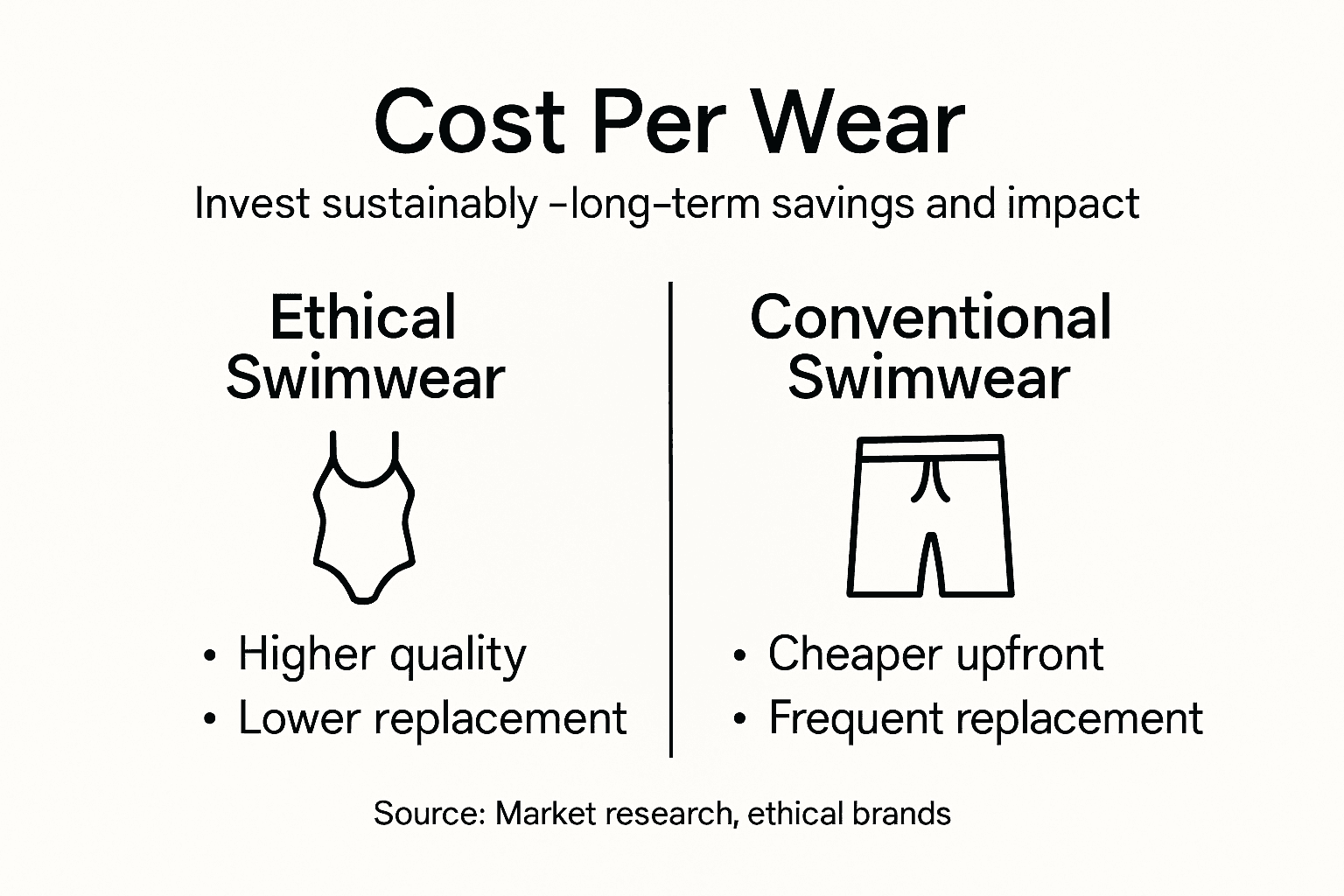
The table below summarizes cost and value comparisons over time:
| Swimwear Type | Average Cost | Uses Before Replacement | Cost Per Use |
|---|---|---|---|
| Ethical | $120 | 60 | $2.00 |
| Conventional | $35 | 12 | $2.92 |
| Multiple Conventional (8 yrs) | $140 | 48 | $2.92 |
The difference seems minimal until you factor in your time and hassle. Ethical beachwear eliminates the annual shopping ritual and decision fatigue. You invest once, wear confidently for years, and never think about it again.
Beyond the math:
- Superior durability means fewer replacements, less shopping, less decision-making
- Consistent performance across seasons prevents color fading and elasticity loss
- Timeless design remains stylish longer than trendy conventional options
- Better fit maintenance means no shrinking or warping after washing
- Peace of mind knowing your purchase aligns with your values
Lifestyle Enhancement Through Values Alignment
Here’s what conventional purchase metrics miss: the psychological and lifestyle benefits of values alignment. When your purchases match your principles, you experience less cognitive dissonance and greater overall satisfaction. You’re not compromising your values for a bargain price, then feeling guilty about the environmental and social cost.
Men who prioritize ethical consumption report higher life satisfaction, stronger sense of purpose, and improved mental wellbeing. This isn’t sentimental—it’s documented. Aligning your spending with your values creates a coherent identity. You’re not just buying swim trunks; you’re expressing who you are and what you stand for.
This matters at the beach. You wear ethical beachwear knowing the materials don’t contain toxic chemicals poisoning oceans you swim in. You know workers who made your trunks earned fair wages and worked in safe conditions. That peace of mind enhances your beach experience more than cheap guilt-inducing alternatives ever could.
Market Growth and Investment Trends
ESG factors increasingly influence retail investment decisions, meaning ethical and sustainable brands command premium valuations and attract capital. This trend creates a virtuous cycle: ethical brands attract investors, receive funding for expansion and innovation, improve their products, and strengthen their market position. Conventional brands cut corners to compete on price, face regulatory pressure, and struggle with brand reputation.
If you care about the long-term viability of brands you support, ethical companies offer better odds. They’re building sustainable business models, not chasing quarterly profits through exploitation. They attract top talent, command customer loyalty, and weather economic downturns better than disposable-fashion competitors.
Ethical beachwear represents investing in your own values, supporting financially sound businesses, and creating lifestyle satisfaction that cheap alternatives simply cannot match.
The Intangible Premium
You’re also paying for intangibles that don’t appear on conventional balance sheets. When you buy from ethical brands, you’re paying for:
Transparency that lets you verify claims through public supply chain information and third-party certifications.
Innovation in sustainable materials and manufacturing processes that improve over time.
Community of like-minded consumers who value quality and responsibility.
Accountability from companies that stake their reputation on their commitments rather than hiding behind greenwashing.
Peace of mind knowing you’re supporting the right practices.
These factors create genuine value that justifies premium pricing. You’re not overpaying for ethical beachwear—you’re paying the true cost of responsible production while avoiding the hidden costs embedded in conventional options.
Pro tip: Track your actual swimwear spending over five years by comparing price multiplied by replacement frequency—you’ll likely discover that ethical beachwear costs less overall while delivering superior durability, style consistency, and psychological satisfaction.
Ethical vs. Conventional Beachwear Choices
Choosing between ethical and conventional beachwear requires understanding what you’re actually trading off. The decision isn’t as simple as “expensive ethical” versus “cheap conventional.” Both options carry hidden costs and benefits that extend far beyond the price tag. The real comparison involves examining durability, environmental impact, labor practices, brand transparency, and long-term value. When you understand these differences, the choice often becomes obvious.
The core distinction lies in how companies prioritize profit versus responsibility. Conventional brands operate on a simple formula: maximize revenue, minimize costs, capture market share. This means sourcing the cheapest materials, manufacturing in countries with lowest labor costs and weakest regulations, and cutting every corner possible. Ethical brands flip the priority: deliver quality products while respecting workers and environment. This requires paying fair wages, using sustainable materials, and implementing transparent supply chains. Understanding ethical consumer differentiation reveals that conscious purchasers evaluate products based on environmental impact, labor practices, and corporate transparency rather than price alone.
The Direct Comparison
Let’s look at what separates these two approaches across key dimensions:
Material sourcing differs fundamentally. Conventional brands use virgin plastics and conventionally-grown cotton treated with pesticides. Ethical brands source recycled materials, organic cotton, and regenerated fibers from certified suppliers.
Manufacturing locations show the cost-cutting reality. Conventional brands manufacture in countries with minimal labor regulations where workers earn poverty wages. Ethical brands pay living wages and maintain verifiable factory conditions, often manufacturing closer to consumer markets to reduce shipping emissions.
Supply chain transparency reveals the most telling difference. Conventional brands are secretive about manufacturing—they rarely disclose factory locations and resist independent auditing. Ethical brands openly share supply chain information, welcome audits, and publish labor compliance reports.
Product lifespan varies dramatically. Conventional swim trunks fade, lose elasticity, and require replacement annually. Ethical beachwear maintains color, shape, and performance for years of regular use.
Here’s how ethical and conventional beachwear differ across major factors:
| Aspect | Ethical Beachwear | Conventional Beachwear |
|---|---|---|
| Material sourcing | Recycled or organic fibers | Virgin plastics, regular cotton |
| Labor practices | Living wages, audits, transparency | Low wages, minimal oversight |
| Environmental impact | Reduced water use, less pollution | High resource use, chemical runoff |
| Long-term value | Fewer replacements, lasting quality | Frequent replacement, lower durability |
Chemical use during production shows stark contrast. Conventional manufacturing uses hazardous dyes, heavy metals, and pesticides without proper containment. Ethical production eliminates or strictly limits chemicals and implements closed-loop systems to prevent water pollution.
What You Actually Pay For
When conventional brands charge $30 to $50, where does that money go? Most flows to marketing, retail markups, and shareholder profits. The actual manufacturing cost might be $5 to $8, meaning the company pockets $15 to $35 in pure profit per garment. That’s only possible through brutal cost-cutting.
Ethical brands pricing at $80 to $150 allocate that differently. Higher material costs reflect genuine sustainability. Fair labor costs increase manufacturing expenses significantly. Certification and auditing add legitimate overhead. Quality construction requires skilled workers paid appropriately. The profit margin exists, but it’s earned through value delivery rather than exploitation.
Here’s what you’re paying for in ethical beachwear:
- Durability that eliminates replacement costs
- Performance that maintains color and elasticity across years
- Transparency proving claims through public documentation
- Safety knowing materials won’t poison oceans
- Worker dignity through verified fair wages
- Environmental responsibility measured and audited
- Brand accountability staking reputation on commitments
- Peace of mind aligning purchases with values
The Environmental Cost Comparison
Conventional swimwear generates significant environmental debt across its lifecycle. Water consumption, chemical pollution, carbon emissions, and waste accumulate from production through disposal. A $40 pair of conventional trunks might carry $60 to $80 in true environmental costs when you account for water pollution cleanup, carbon sequestration, and ecosystem damage.
Ethical beachwear dramatically reduces these costs. Lower water consumption, eliminated chemicals, reduced carbon footprint, and decades-long lifespan mean true environmental cost aligns much closer to purchase price. You’re not externalizing environmental damage onto future generations.
The cheapest beachwear option always extracts the highest cost from workers, ecosystems, and your conscience—while the investment in ethical alternatives delivers superior value across every dimension that matters.
Making Your Choice
Your decision depends on what you prioritize. If price is your only concern, conventional wins short-term. If quality, values alignment, long-term savings, and environmental impact matter, ethical beachwear is the obvious choice.
Most men discover that once they switch to ethical beachwear, they never return to conventional options. The superior quality, timeless design, and peace of mind make the investment compelling. You’re not choosing between a cheap compromise and an expensive luxury—you’re choosing between a false bargain that costs more over time and a genuine investment that delivers superior value.
Pro tip: Create a personal comparison by tracking what you actually spend on swim trunks over three years, including replacements of conventional options—the total will likely exceed what you’d spend on one or two quality ethical pairs that last significantly longer.
Make a Positive Impact with Stylish Ethical Beachwear
The article reveals the pressing challenge of finding swimwear that truly respects both the environment and the hardworking people behind its production. If you want swim trunks that combine durability, eco-friendly materials, and fair labor practices, then choosing ethical beachwear is essential. It is not just about buying stylish swimwear but investing in quality pieces that reduce plastic pollution, conserve water, and support living wages for factory workers.
At Le Club Original, we specialize in sustainable swimwear crafted to meet these high standards. Our eco-conscious products use recycled fabrics and organic fibers designed to last season after season while helping to protect the oceans you enjoy. Plus, every purchase supports fair labor conditions and transparent supply chains. Discover our best sellers and experience how ethical fashion delivers superior comfort and values alignment without compromising style.
Ready to upgrade your beachwear with responsible choices that make a difference now? Explore our collection at Le Club Original and enjoy up to 50% off sitewide plus free shipping on orders over $50. Embrace swimwear that respects the planet and the people making it today.
Frequently Asked Questions
What materials are commonly used in ethical beachwear?
Ethical beachwear is typically made from eco-friendly materials such as recycled polyester, organic cotton, regenerated fibers like Tencel, and blends of hemp or linen. These materials are chosen for their reduced environmental impact and durability.
How does ethical beachwear impact the environment compared to conventional swimwear?
Ethical beachwear significantly reduces environmental harm by minimizing water consumption, eliminating hazardous chemicals, and lowering carbon footprints during production. This type of swimwear often lasts longer, which further decreases overall resource usage over time.
Why is fair labor important in the production of swimwear?
Fair labor practices ensure that workers receive living wages, work in safe conditions, and have the right to organize. This not only supports the dignity of workers but also helps to promote sustainable and responsible manufacturing practices within the fashion industry.
How do I evaluate the ethical commitment of a beachwear brand?
You can evaluate a brand’s ethical commitment by checking for transparency in their supply chain, third-party certifications (like Fair Trade), and detailed information about their manufacturing practices. Look for brands that share reports on labor compliance and environmental impact.